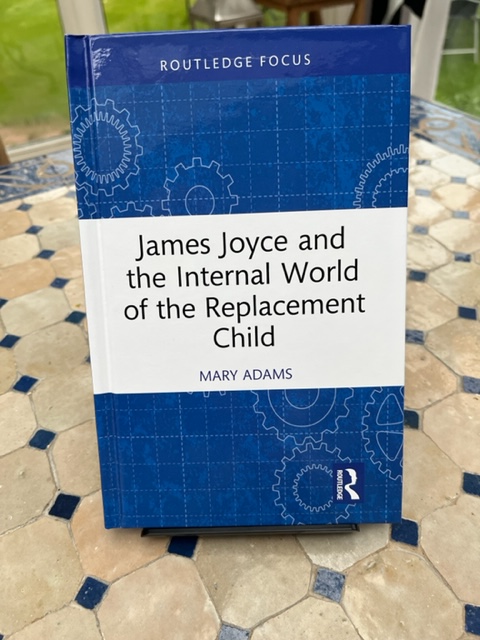
James Joyce and the Internal World of the Replacement Child Routledge 2022
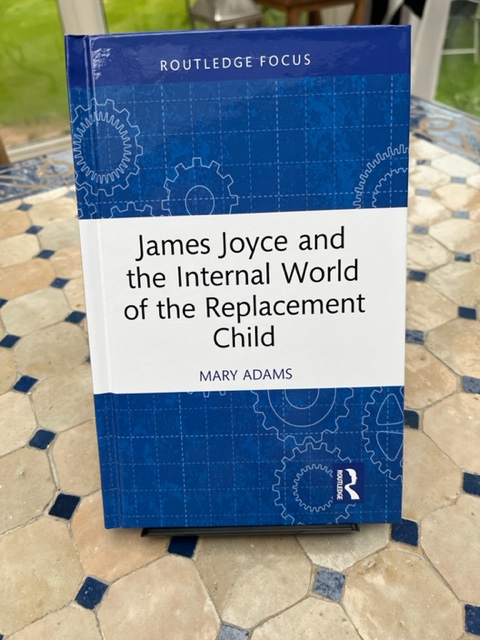
“The Joyce ‘oeuvre’ is haunted by ghosts, shades, elusive and allusive fleeting asides, heaps of broken images where the ‘sun beats and the dead tree gives no shelter’. The bitterness of usurpation and betrayal stalk his pages and to the dismay of many a reader emotional passion can be obscured by his ‘catalectic tetrameter(s) of iambs marching’. But what or who haunts this vast oeuvre of James Joyce? Mary Adams unlocks the puzzle of the haunting in her theorising of ‘the replacement child’. She illuminates the harsh and lyrical linguistic landscape of Finnegans Wake, decompressing and revealing huge emotional intensity on the page. Reminding us that the unconscious is in the language not behind it! Adams gives us a deeply poignant and vivid portrait of the man, his family, his work and his world, and gives a voice to the silence around the death of Joyce’s ‘first born sibling’. Her analysis gives us a heartfelt full-blooded picture of Joyce the man, the artist and genius.” Paul Caviston FRCPsych
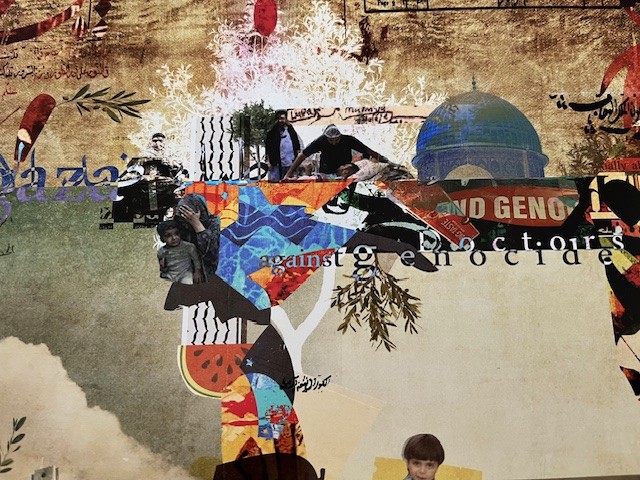
POETRY AND RE-IMAGINING IN A TIME OF CRISIS ‘Changing the very terms of the dilemma’
Psychoanalytic Psychotherapy 2024
The author compares the power of imagery in poetry with the unconscious images and re-imagining that allow us to see things in a new light in psychotherapy. Palestinian poetry illuminates their world and the devastation happening in Gaza in the way dreams capture our inner world. Emphasis is given to the role of the imagination in effecting social change, seen remarkably in the ‘Good Friday Agreement’ in Northern Ireland. The poetry of Seamus Heaney, for example, is linked with a fundamental perceptual shift around issues of national sovereignty. In his long-term support for Palestine, Heaney looked to poetry to redress the injustice and to counter the silencing and ‘turning a blind eye’. Nakba denial is seen as attacking the very life sustaining act of re-imagining.
https://www.tandfonline.com/doi/full/10.1080/02668734.2024.2416959?src=exp-la
‘The Beauty of Finnegans Wake. Remembering and Re-imagining: A Return to the Father’
British Journal of Psychotherapy 34 467-483.
2018
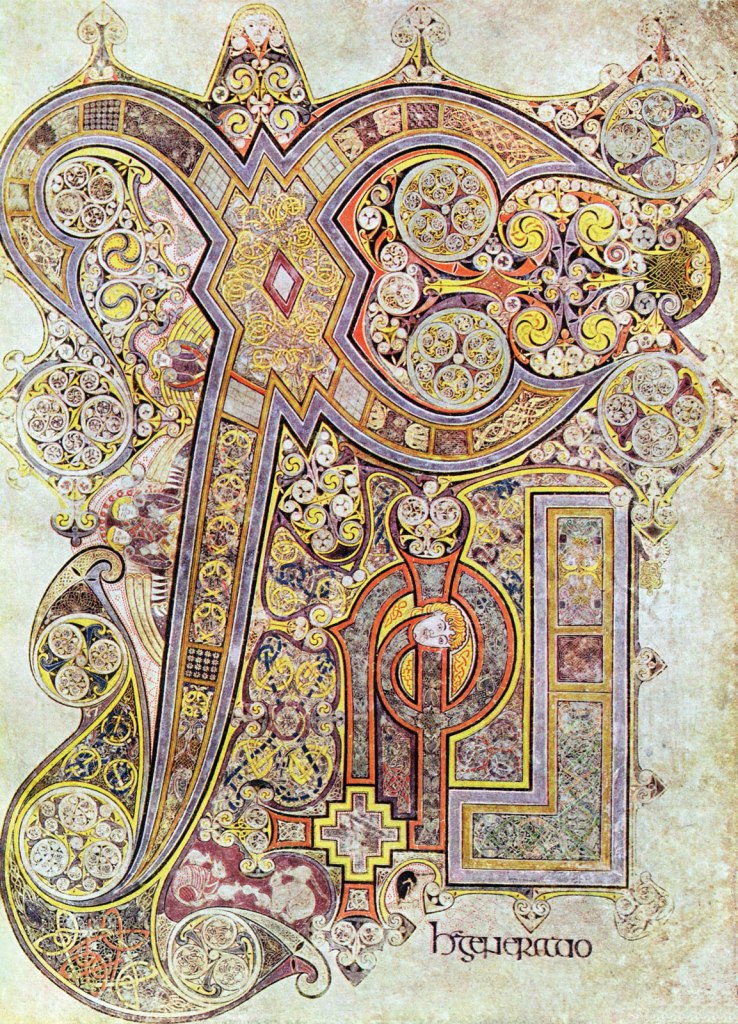
James Joyce’s immersion in Finnegans Wake is seen as his way of controlling his imagination and holding together emotionally. A sensitive, bright and impressionable child, he had much to contend with, including being a ‘replacement child’, born into his parents’ grief at losing other children. This can create lasting guilt and confusion in the surviving child: do they have the right to an existence of their own, or should they, like Joyce, go into exile? The paper describes the fears that plagued Joyce and how a proleptic imagination, and his phenomenal memory, gave him a sense of control. Placing Finnegans Wake in a timeless dream world gave Joyce space and new freedom, but within a carefully boundaried structure. Joyce’s love affair with language has him playfully crafting his own elaborate Book of Kells, in which punning and parody distract from the grief which underlies the work. At the centre is a Dublin family in a story which loosely parallels Sophocles’ Oedipus, playing out the internal world of the ‘replacement child’ who fears he was responsible for the siblings’ deaths. The beauty of Finnegans Wake is the extraordinary way that Joyce stays afloat, producing a unique masterpiece of levity and poetry.
Image: The Book of Kells; Trinity College, Dublin

‘Trapped in a claustrum world: the proleptic imagination and James Joyce’s Ulysses‘
Doing Things Differently: The Influence of Donald Meltzer on Psychoanalytic Theory and Practice (Tavistock Clinic Series) Paperback – edited by Margaret Cohen, Alberto Hahn.
2017
This paper describes similarities between James Joyce and two patients who lost siblings in childhood. The patients felt frighteningly cut adrift and abandoned by a grieving ‘dead’ mother, feared they had caused the siblings’ deaths and were paralysed by the belief that they actually remain lethal to others. Like Joyce, feeling at the mercy of a highly active imagination, they sought a sense of control by developing a ‘proleptic imagination’. The paper looks at their feeling guilty outsiders and, too afraid to freely engage with others, how they attempt to get inside everywhere and control from within. Joyce’s Ulysses is seen as a picture of this ‘getting inside’, an extraordinarily detailed and poignant bringing alive of Meltzer’s claustrum world, with Leopold Bloom locked in the maternal rectum, Molly Bloom in the genital region, and poet, Stephen Dedalus, caught in the head-breast, unable to emerge into adulthood. Ulysses portrays a stuck and confusing world which Joyce himself called ‘a paralysis of the insane’. Wyndham Lewis describes it as a ‘telling from the inside’, and Seamus Heaney, calling Joyce ‘an outsider from the start’, says, “his work is a performance, the connoisseur of styles is showing off, but at the same time the hurt human being is giving vent to his rage.”
A link is made with Shakespeare who is a presence throughout Ulysses and was himself a replacement child. A comparison is also made with Samuel Beckett who was highly identified with Joyce.
‘Survivor Guilt, Fear, and the Freedom to Imagine’
2014, unpublished
Dan Twomey Prize paper, British Psychoanalytic Association.

‘Classics Revisited: Donald Meltzer: The relation of anal masturbation to projective identification’
2004
Journal of the British Association of Psychotherapists, 42(2): 158-168.
Abstract: Donald Meltzer’s 1966 paper is considered a classic in its discussion of the role of anality and projective identification in the development of the pseudo-mature personality. This concept is similar to Winnicott’s ‘as if’ personality and Deutsch’s ‘false self’, but Meltzer’s focus is on a phantasy entry into the internal world of the internal object. The paper describes how this develops from a child’s hatred of dependence and how it manifests in the analytic relationship. Meltzer’s paper is difficult in the breadth of ideas it covers and in the picture of the inner world. Perhaps most difficult to grasp is the specific kind of projective identification that he is describing—a projective identification with the internal object, an intrusive identification, in fact, with the phantasied intrusion taking place primarily through the anus. The paper follows Melanie Klein’s (1946) introduction to the concept of projective identification and Paula Heimann’s (1962) work on anality. It is ranked, along with three other major works—Bion’s ‘Attacks on Linking’ (1959), Rosenfeld’s ‘Contribution of Psychotic States’ (1971), and Joseph’s ‘Projective Identification: Some Clinical Aspects’ (1987)—as a landmark in Kleinian thinking about projective identification. “Meltzer’s paper”, says Eliabeth Spillius, “describes the phantasies of projective identification with internal parents expressed in and accompanied by anal masturbation, leading to denigration of parental functions and to denial of dependence on internal parents, and thus to false independence and ‘pseudo-maturity’ in the individual.”
Beyond this, it is a paper that paves the way for Meltzer’s subsequent contribution: his work on the ‘claustrum’, i.e. the unconscious dwelling place of this kind of pseudo-mature individual; his attention to the reality of internal space; the geographical compartments of the phantasy internal mother; and his work on delusional identification. Meltzer takes us right inside the internal world discovered by Klein. As he put it, “My contribution has consisted of an invasion of a space that is really a mythological space—the unconscious.” Klein, he says, tended to treat projective identification as a ‘psychotic mechanism’ which operated mainly with external rather than internal objects. Meltzer, who later described projective identification as ‘the most important and most mysterious concept in psychoanalysis’, saw this particularly intrusive kind as an essentially anal process (anal suggesting an expelling of unwanted bits of the self). He called it ‘intrusive identification’ to clarify the pathology involved and distinguish it from the kind of projective identification (an unconscious form of communication) described by Bion.

‘Dreams and the Discovery of the Inner World’
2002
Abstract: Donald Meltzer’s theory of dreaming provides the basis for an exploration of the way we think about dreams in psychoanalytic practice today. Using Meltzer’s ideas on dimensionality and symbolic thinking, she looks at how dreams can introduce patients to their own inner worlds and transform a sense of inner emptiness and isolation into a rich and meaningful three-dimensional world of intimate relating. She notes the impact of Klein’s discovery of the internal world and the difficulty Freud had in trying to approach dreams without the concept of an inner world. Bion saw dreams as the articulation of emotion and meaning and as a form of unconscious thinking. She looks at patients’ reactions to their own dreams and the anxieties that bringing a dream can arouse. In conclusion she describes the valuable role that dreams play in introducing patients to the beauty of the analytic process itself.
‘The Understudy: a case of adhesive identification’,
Journal of the British Association of Psychotherapists, 33, Vol 2, Part 2.
1997
Abstract:
In their work with autistic children, Esther Bick and Donald Meltzer made an important discovery regarding processes of identification. They found that a striking characteristic of autistic children was the lack of a sense of an inside, either in themselves or their objects. As a result, projective identification was not happening because there was nothing for them to project into. Instead a form of identification by imitation had been adopted. They describe these children’s worlds as two-dimensional and their objects ‘paper thin’ as though there were no enclosed spaces, only surfaces.
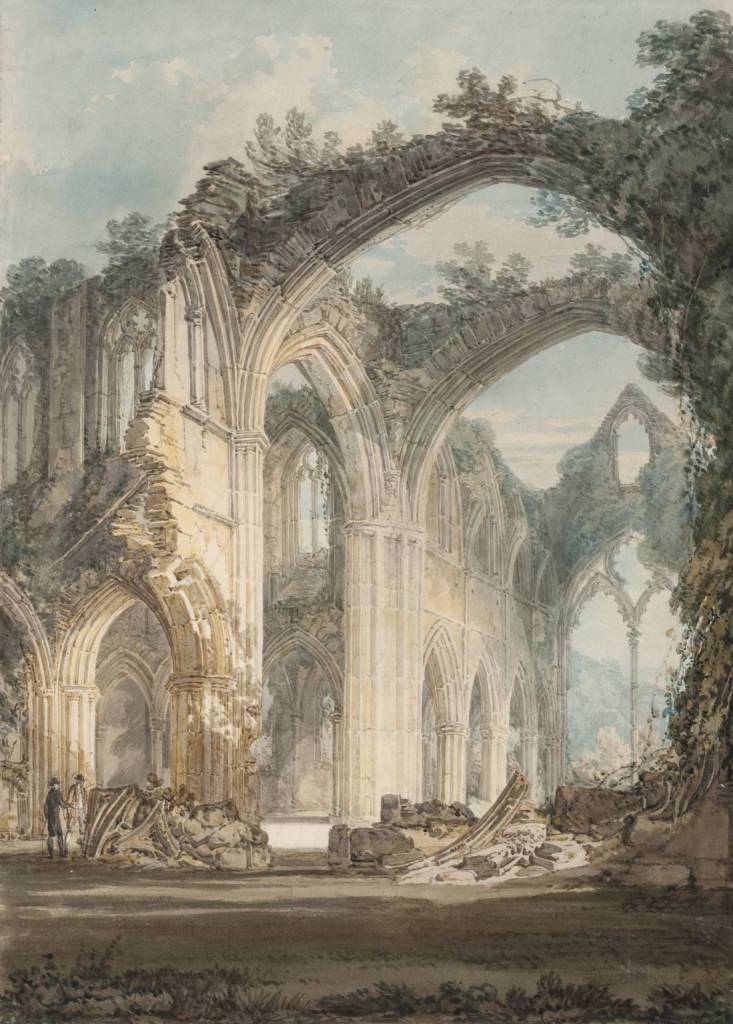
Like Tintern Abbey, Meltzer says, the maternal object was experienced as ‘open to the weather and the marauder alike’. Wandering through Tintern as it is now, one can go through a doorway, as if to go from outside to inside, and find oneself outside again—-unless in the imagination one re-creates the sense of an internal space. The mind of the autistic child, however, if unable to imagine an ‘inside’, sees only a concrete structure of exposed surfaces. The implications of experiencing the maternal object this way are profound as it affects not only the child’s conception of the object as container, but also its sense of space and time. No feelings or images can be taken in and thought about because there is no inside in which to hold them. Beginnings and endings, like inside and outside, merely converge leaving no space for experiencing and developing in between.
Image: JMW Turner
’The Couple and the Group: group psychotherapy with incest survivors’
British Journal of Psychotherapy
2002
Abstract: This paper provides an account of a six‐month psychotherapy group for incest survivors in the setting of an all‐women centre. It looks at the high level of anxiety expressed by the group members and their struggles with the two women therapists. The paper stresses the attempts to split the co‐therapist couple and the importance of resisting this splitting in order to offer protection and containment to the group. It suggests that the experience of having this containment provided by two women therapists challenged their denigration of women/mothers, which in turn affected their ability to stand up to their abusers. The wish to find a way to relate to their own mothers is considered a powerful motivation for members having joined the group. This is seen as an important part of the separation‐individuation process which the incest had denied them.
‘Becoming A Daughter’
(unpublished, presented at Meltzer conference, Florence)
2000
Abstract: In this paper I look at how a sense of belonging is an essential part of the experience of intimacy, and how the way the aesthetic conflict, as described by Meltzer, is managed between parent and child is critical for this sense of belonging. It is an issue of particular poignancy where we are dealing with what André Green has called the ‘Dead Mother Syndrome’. A striking feature in these patients was the lack of an inner sense of belonging to a mother. Instead they seemed to be floating about with no moorings, trying to create their own place where they might belong. Even though their parents had been physically present, a sense of emotional nurturing was missing. Despite conveying a warmth and vitality, these two patients described feelings of ‘being on the outside’, ‘always living on the edge of an abyss’, feeling ‘empty’ inside, and perhaps most of all, feeling they ‘did not matter’. Both are attractive women in their early forties, married with children and successful in their careers. Self-reliance and ‘managing others’ became their focus, blocking out a deep belief that they were unlovable.

‘Psychotherapists’ Attitudes toward lesbianism: a study of heterosexual bias and therapy with the female homosexual’,
1978
Master’s thesis for Smith College School for Social work, USA.
 Mary Adams